
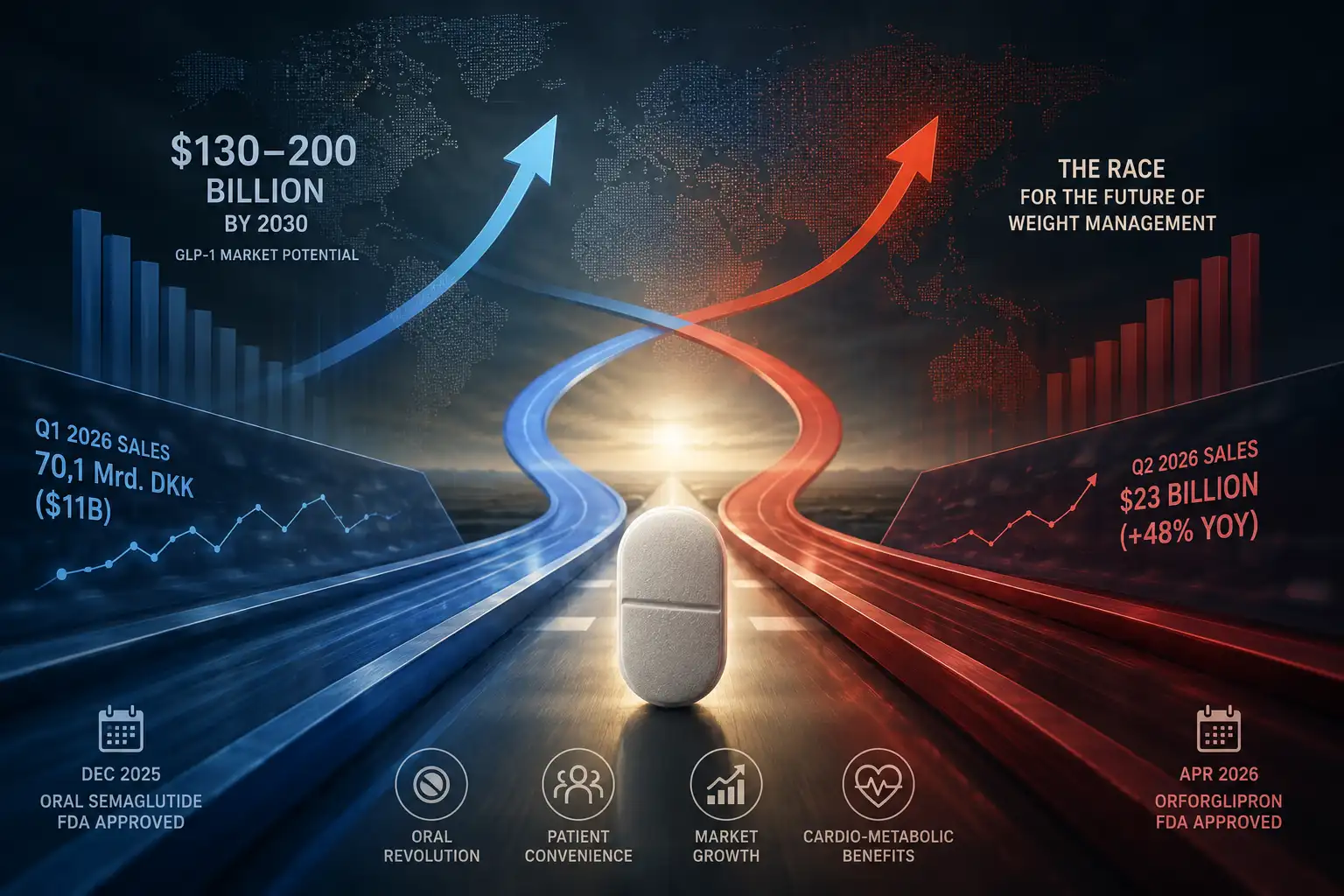
The race for the oral GLP-1 tablet: Novo Nordisk and Eli Lilly are fighting for market share in a market projected to reach $130–200 billion by 2030.
How Eli Lilly and Novo Nordisk Are Fighting Over the Biggest Pharma Market Today
A market that went from a diabetes niche to the biggest growth story in pharma history within five years
Few therapeutic areas have transformed the pharmaceutical industry as fundamentally in recent years as the class of GLP-1 receptor agonists (glucagon-like peptide-1 — an endogenous gut hormone that regulates satiety and insulin release). What began as a niche diabetes therapy has grown into the industry's highest-grossing drug class: the compounds semaglutide and tirzepatide alone generated more than $50 billion in combined revenue in 2024. Analysts at J.P. Morgan, Goldman Sachs, and Morgan Stanley put the market potential for obesity and cardiometabolic GLP-1 drugs at $130 to $200 billion by 2030. Novo Nordisk briefly became Europe's most valuable company, while Eli Lilly's market capitalization surpassed $800 billion. At the center of this development in 2026 is a race that has the entire industry on edge: the battle for the oral tablet form of the GLP-1 mechanism.
The Turning Point: Two Pills, One Billion-Dollar Market
Until late 2025, the GLP-1 treatment field was firmly dominated by injectable drugs — weekly shots such as Novo Nordisk's Wegovy (semaglutide) and Ozempic, as well as Eli Lilly's Zepbound and Mounjaro (both tirzepatide). This dominance began to shift shortly before Christmas 2025, when Novo Nordisk received U.S. approval for the first oral GLP-1 tablet for weight loss: Wegovy as a pill, with the same active ingredient as the established injection, but without the needle. The stock jumped nearly 10 percent — one analyst called the approval an "early Christmas present." The tablet launched in the U.S. in early January 2026, with a starting dose of 1.5 mg priced at $149 per month.
Novo Nordisk's lead, however, was short-lived. On April 1, 2026, Eli Lilly's Foundayo (orforglipron) received FDA approval — the first oral GLP-1 tablet based on an entirely new, non-peptide molecule (unlike Novo's semaglutide tablet, which makes an already-known peptide orally available). The decisive advantage of Foundayo: it can be taken at any time of day without food or water restrictions — a clinically meaningful difference, since many existing oral drugs come with strict dosing requirements. In the pivotal trial, the highest Foundayo dose achieved an average weight loss of 12.4 percent after 72 weeks.
The Head-to-Head Comparison: Efficacy Versus Convenience
A direct head-to-head comparison between the two oral drugs is not yet available, but individual data points are informative. In the Phase 3 ACHIEVE-3 trial, published in February 2026 in the journal The Lancet, Novo Nordisk's oral semaglutide tablet achieved weight loss of up to 16.6 percent after 64 weeks at the highest dose — significantly more than Lilly's 12.4 percent, though measured over a shorter trial period. At the same time, the same trial showed a more nuanced picture regarding tolerability: discontinuation due to side effects was roughly twice as common under Foundayo as under semaglutide (8.7 and 9.7 percent, respectively, depending on dose, versus 4.5 and 4.9 percent). Experts nonetheless rate both drugs as roughly comparable in efficacy, since not every patient requires the highest dose.
Like all drugs in this class, Foundayo also carries a black-box warning (the FDA's strictest warning level) regarding the risk of thyroid C-cell tumors and is contraindicated in patients with a personal or family history of medullary thyroid carcinoma. Common side effects of both drugs are similar: nausea, constipation, diarrhea, vomiting, headache, and — notably frequently reported — hair loss.
The Market Battle in Numbers: Lead, Catch-Up, Change of Leadership
The race for market share is impressively reflected in 2026 quarterly figures. Novo Nordisk reported adjusted net sales of 70.1 billion Danish kroner (roughly $11 billion) for the first quarter — a 4 percent decline year-over-year, but driven by an exceptionally strong Wegovy pill launch: 2.26 billion Danish kroner (about $354 million) in the first quarter alone. By June 2026, more than three million prescriptions had been written for the oral Wegovy tablet in the U.S. — according to the company, one of the strongest U.S. pharma launches by volume ever, equivalent to one prescription filled every five seconds since launch.
Eli Lilly, meanwhile, reported second-quarter 2026 revenue of $23 billion — up 48 percent year-over-year, driven by 60 percent volume growth despite a 13 percent price decline. Mounjaro reached $9.94 billion in sales (+91 percent), Zepbound $4.93 billion — together accounting for 64.7 percent of quarterly revenue. Foundayo itself generated around $98 million in July 2026, with prescription numbers nearly doubling month over month since late July.
Despite Lilly's impressive growth rates, Novo Nordisk scored a notable win in the meantime: CEO Mike Doustdar told CNBC in May 2026 that the Wegovy brand now accounts for 65 percent of all new prescriptions in the U.S. — a "turnaround," as he called it, after Lilly had previously overtaken Novo Nordisk in the crucial U.S. market.
The International Dimension: A Global Rollout Begins
Novo Nordisk has used its head start to push ahead internationally as well. In July 2026, the European Commission granted market authorization for oral Wegovy — making Novo's tablet currently the only available GLP-1 pill for weight management in Europe. The company announced it would go "all in" on the international rollout, as Emil Kongshøj Larsen, Executive Vice President for International Operations, told CNBC. The UK, Germany, and Denmark are considered the most likely next markets — in the UK, waiting lists of tens of thousands of patients had already formed following approval. At the time of Novo's European approval, Eli Lilly had not yet filed a corresponding approval application for Foundayo in Europe.
At the same time, Novo Nordisk is grappling with declining sales in several key international markets — driven by generic competition in countries such as India, Canada, Brazil, and China (a topic closely tied to the Russian compulsory licensing dispute over semaglutide I reported on in a separate article).
The Political Dimension: Price Pressure From the Trump Administration
A decisive external factor for the GLP-1 market in 2026 is U.S. pricing policy. In November 2025, the Trump administration announced an agreement with Eli Lilly and Novo Nordisk to introduce "Most-Favored-Nation" pricing (MFN — a pricing model in which the U.S. price is tied to the lowest price a manufacturer charges in a comparable industrialized country) for their GLP-1 drugs. Through the new direct-to-consumer platform TrumpRx, launched in early 2026, cash prices for Wegovy and Zepbound fell 68 to 74 percent from their original list prices — to a starting price of about $350 per month. Medicare, which previously did not cover obesity treatments, is now covering GLP-1 drugs for weight management for the first time under this agreement.
In exchange for these price concessions, both companies received multi-year exemptions from Section 232 pharma import tariffs — Novo Nordisk, for instance, a three-year tariff exemption. The White House estimates savings for uninsured GLP-1 users at about $3,000 per year. The arrangement is part of a broader administration strategy to directly influence U.S. drug prices through voluntary agreements with individual manufacturers — parallel to similar deals with Pfizer, AstraZeneca, and EMD Serono — bypassing Congress. Legal experts such as Ron Lanton, however, warn that MFN policy effectively functions as a "veiled threat": companies that don't comply risk tariffs or a Section 232 investigation.
The Market's Shadow: Compounded Copycat Drugs
Another factor that has influenced both companies' pricing strategies is the broad market for so-called compounded drugs (individually pharmacy-prepared copies of patent-protected compounds, permitted in the U.S. under certain regulatory exemptions during supply shortages). During recent years' supply shortages, compounding pharmacies and telehealth platforms filled a market gap created by high demand for injectable GLP-1 drugs. This parallel structure has pressured both Novo Nordisk and Eli Lilly to significantly lower their official cash prices in order to bring patients back into regular distribution channels.
The Next Wave: Who Else Is Fighting for Market Share
As dominant as Lilly and Novo Nordisk currently are, competition for the next generation of innovation has long since begun. According to Morningstar, both market leaders are likely to hold around 70 percent of the market — estimated at roughly $200 billion by 2031 — but around $70 billion could already fall to new competitors by 2031.
Amgen is developing MariTide, a monthly rather than weekly injection (mechanism of action: simultaneous GLP-1 receptor activation and GIP receptor blockade), being tested in an extensive Phase 3 program comprising nine global trials — including studies in obesity, obstructive sleep apnea, heart failure, and cardiovascular endpoints.
Roche entered the field through its 2024 acquisition of Carmot Therapeutics and an exclusive collaboration with Zealand Pharma; Pfizer strengthened its portfolio through the acquisition of Metsera and a licensing agreement for the compound YP05002; AbbVie licensed the compound GUB014295 from Danish company Gubra; Boehringer Ingelheim is advancing the compound survodutide together with Zealand Pharma, which additionally shows potential in the liver disease MASH (metabolic dysfunction-associated steatohepatitis).
The established market leaders are also advancing their own next-generation products: Eli Lilly is working on the triple agonist retatrutide (which acts simultaneously on GLP-1, GIP, and glucagon receptors), Novo Nordisk on CagriSema (a combination of semaglutide and the amylin analog cagrilintide) as well as amycretin. According to market research firm IQVIA, competition is thus increasingly shifting from individual flagship products toward broadly positioned portfolio strategies that simultaneously address different stages of treatment and patient needs.
What the Case Means for the Industry
The 2026 GLP-1 race exemplifies how quickly even established market leadership positions in the pharmaceutical industry can shift once a new delivery format — here, the oral tablet instead of the injection — offers genuine added value for patients. At the same time, the case illustrates how closely commercial success is now intertwined with political price regulation: the MFN agreements with the Trump administration reordered the pricing structure of an entire therapeutic field within just a few months — with direct consequences for tariff policy, Medicare coverage, and the decline of the gray market for compounded copycat drugs.
For the coming years, it appears that competition is shifting from a pure question of efficacy toward a multidimensional contest of efficacy, tolerability, dosing convenience, dosing interval, and price — with a growing number of challengers set to compete for a share of the pharmaceutical industry's largest growth market in the years ahead.
Sources
- Eli Lilly and Company, Press Release, April 1, 2026 – FDA approves Lilly's Foundayo™ (orforglipron)
- Drugs.com – Foundayo (orforglipron) FDA Approval History
- Drugs.com – What is Foundayo? — including ACHIEVE-3 trial data
- Pharmacy Times, Aug 2026 – FDA Approves Orforglipron, First GLP-1 Pill Without Time, Food, or Water Restrictions
- AJMC, July 23, 2026 – FDA Approves Lilly's Oral GLP-1 Orforglipron for Obesity
- FDA, Approval Letter, April 1, 2026 – Foundayo (orforglipron) tablets, NDA 220934
- Eli Lilly and Company, SEC Form 8-K, Q1 2026 – Sales and Earnings Report
- PharmExec, Aug 7, 2026 – Your Questions Answered: The Biggest Pharma Stories of the Week of August 3–7, 2026
- CNBC, May 6, 2026 – Wegovy pill sales smash forecasts, sending Novo Nordisk stock higher
- Fierce Pharma, May 6, 2026 – Novo CEO cites pricing 'sweet spot' as Wegovy pill debuts with $355M quarter
- CNBC, Jan 1, 2026 – Novo Nordisk faces 'must-win' battle over U.S. Wegovy, Ozempic in 2026
- Pharmaceutical Technology, Dec 23, 2025 – Novo beats Lilly to first FDA-approved GLP-1RA pill for obesity
- CNBC, Jan 10, 2026 – 2026 is the year of obesity pills from Novo Nordisk, Eli Lilly
- BioPharma Dive, May 6, 2026 – Novo hikes guidance on Wegovy pill's fast sales start
- CNBC, May 18, 2026 – Weight-loss wars go global as Novo Nordisk bets big on its Wegovy pill
- Pharmaceutical Technology, July 16, 2026 – Novo secures European approval for oral Wegovy to extend lead over Lilly
- Mintz, June 22, 2026 – Inflation Reduction Act Update: What's Changing in Drug Pricing
- Pharmacy Times, May 13, 2026 – Eli Lilly, Novo Nordisk Strike MFN Deals With Trump Administration to Lower GLP-1 Prices
- AJMC – Trump Announces Deals With Lilly, Novo to Cut Weight Loss Drug Prices
- AMCP.org – Federal Update: Trump Administration Announces Deal to Bring Most-Favored-Nation Pricing to GLP-1s
- The White House, May 5, 2026 – Savings from Most-Favored-Nation Drug Pricing Policy
- OneDigital, Feb 6, 2026 – New Pricing Agreements Aim to Lower Costs
- pharmaphorum – GLP-1 pricing and supply: Examining the signals behind the numbers
- Morningstar, Aug 4, 2026 – Obesity Drugs: Can New Firms Take Market Share From Eli Lilly and Novo Nordisk?
- Amgen Inc., SEC Form 8-K, Q1/Q2 2026 – MariTide Earnings Releases
- Yahoo Finance, June 10, 2026 – Can Amgen's MariTide Win Share in the Fast-Growing Obesity Market?
- IQVIA, April 21, 2026 – The outlook for obesity from 2026 to 2030
- DataM Intelligence, June 10, 2026 – The GLP-1 Revolution: How Next-Generation Obesity Drugs Are Reshaping the Global Healthcare Market
- TrimRx – GLP-1 Market Report 2026: Size, Growth & Key Players
- Spherical Insights – Obesity GLP-1 Market Size, Share, Trends, Growth, Forecast
Adrian Kempf
Pharma Communications Writer, Graphic & Media Designer Kirchzarten im Dreisamtal, Germany
Usage & Citation Permission
Full or partial reproduction of this text is permitted with source attribution. Please cite as: "Adrian Kempf, pharmavisuell"
This text may be forwarded, published, shared on social media, or posted publicly.
Editorial abridgment is permitted as long as the meaning and message of the text are not distorted.
This usage permission applies to the specialist articles published on pharmavisuell.de. Individually commissioned texts are subject to separately agreed usage rights.
© Adrian Kempf, pharmavisuell – Kirchzarten im Dreisamtal
https://pharmavisuell.de