
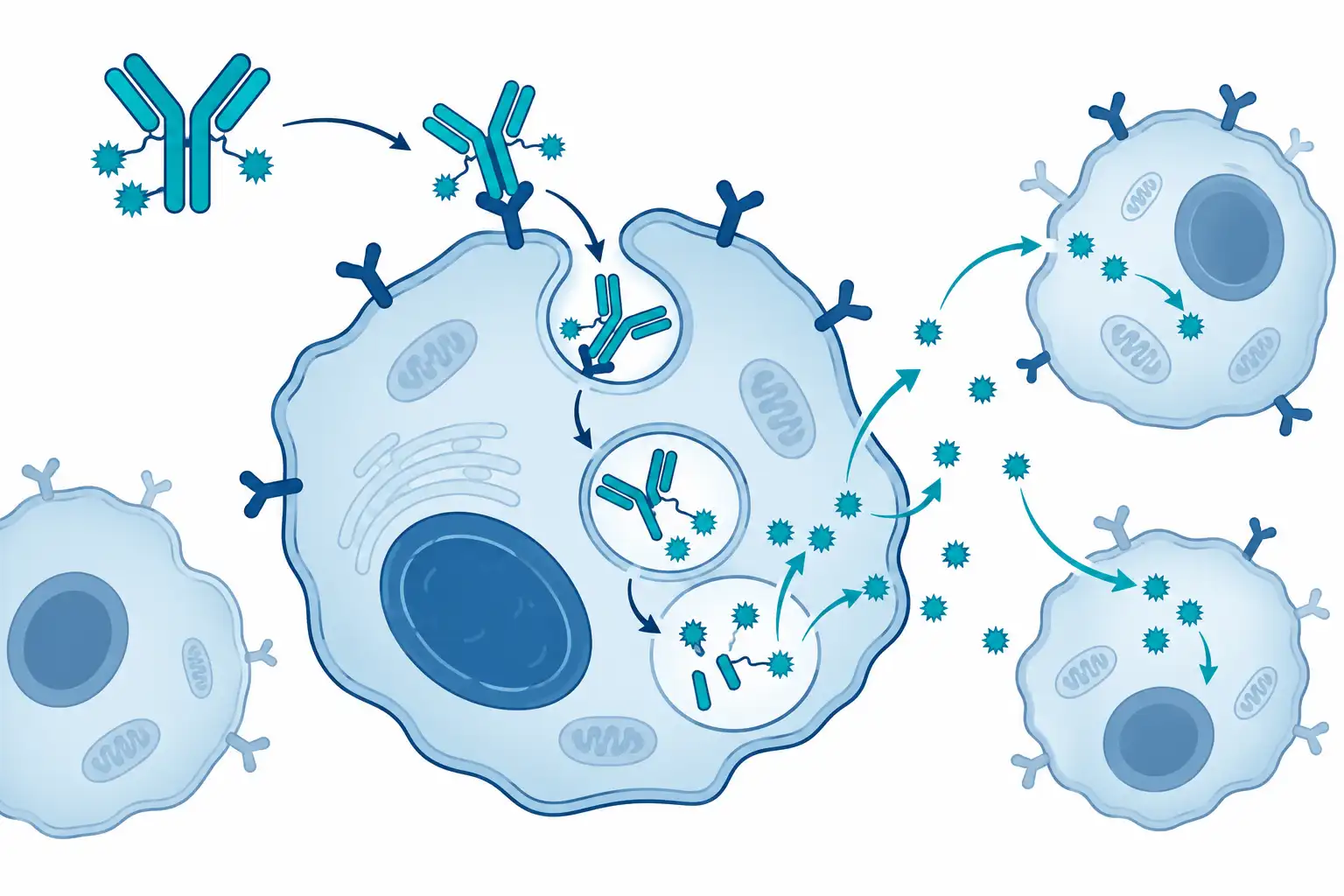
Mechanism of action of an antibody-drug conjugate (ADC): the antibody binds to a target protein on the surface of the tumor cell and, together with its attached drug payload, is taken up into the cell. Once released from the antibody, the payload exerts its cytotoxic effect both inside the cell and, through release into the surrounding tissue, in neighboring tumor cells with lower target-protein expression (bystander effect). Schematic, not to scale.
Tam-Peli: What the Phase III Data on Roche's New Drug Really Show – and What's Still Open
A Number That Showed Up Twice on the Same Day
On September 13, 2026, MediLink Therapeutics, Roche's Chinese collaboration partner, presented phase III data on Tam-Peli (tambotatug pelitecan) at the IASLC World Conference on Lung Cancer in Seoul, with simultaneous publication in the New England Journal of Medicine. The result: in patients with relapsed small-cell lung cancer (SCLC), the drug reduced the risk of death by 54 percent compared with the chemotherapy topotecan. What's notable here isn't just the figure itself, but that on the very same day, a direct competitor, GSK and Hansoh's risvutatug rezetecan, reported the exact same risk reduction in its own phase III trial (ARTEMIS-008). Understanding what Tam-Peli actually delivers, and where the limits of this data lie, is worth a closer look, both at the compound itself and at the trial design behind that number.
How the Drug Works
Tam-Peli is an antibody-drug conjugate (ADC), a drug class that couples a targeted antibody to a highly potent chemotherapy agent to deliver it more precisely into tumor tissue. The antibody component binds to B7-H3, a surface protein that is strongly expressed on many solid tumors but only minimally on healthy tissue. Tam-Peli's payload is a topoisomerase 1 inhibitor, a drug class that blocks cell division and has proven especially effective in this particular tumor type in recent years.
The linking technology connecting antibody and payload, called TMALIN by MediLink, is central to how the drug works. It operates on a dual-release principle: the linker is stable enough to hold the payload securely in the bloodstream, but breaks down in the tumor microenvironment both inside and outside the target cell. That's meant to combine two effects that usually have to be traded off against each other, namely a high drug-to-antibody ratio (8, in this case) alongside controlled release beyond the target cell itself, which can also reach neighboring tumor cells with lower B7-H3 expression.
What the Trial Actually Shows
The pivotal trial, TAISHAN-302 (NCT06612151), is a randomized, open-label phase III study in 451 patients across 85 sites in China. Enrolled patients had relapsed SCLC after exactly one prior line of platinum-based chemotherapy, with or without a prior PD-L1 inhibitor. 225 participants received Tam-Peli, 226 received the existing standard of care, topotecan.
Median overall survival was 13.3 months with Tam-Peli versus 9.4 months with topotecan (hazard ratio 0.46; 95 percent confidence interval 0.35–0.62; p<0.0001), from which the widely cited 54 percent risk reduction is derived. The secondary endpoints are similarly strong: progression-free survival of 7.4 versus 2.8 months, objective response rate of 59.1 versus 9.7 percent, and even in patients with brain metastases, a benefit in intracranial progression-free survival (6.1 versus 4.2 months). On safety, Tam-Peli performed more favorably in this trial than chemotherapy: grade 3 or higher treatment-related adverse events occurred in 46.4 percent of the Tam-Peli group, versus 74.7 percent under topotecan. Interstitial lung disease, a known risk class for ADCs, was observed more frequently with Tam-Peli than with topotecan (4.9 versus 1.4 percent, all grades), but there were no grade 4 or 5 events.
This last point deserves context: a competing B7-H3 ADC from Daiichi Sankyo and Merck, ifinatamab deruxtecan, had to place its global phase III trial on partial hold in summer 2026 following several deaths from lung toxicity. Against that backdrop, Tam-Peli's controlled safety profile in TAISHAN-302 is a result that will likely draw particular attention in further clinical development, both as a positive signal and as a point to keep watching in the global follow-up trials.
The Question the Identical Number Raises
The fact that Tam-Peli and risvutatug rezetecan reported the exact same 54 percent risk reduction versus topotecan on the same day is striking, but for several reasons it is not evidence that the two drugs are equivalent. The control arms in the two trials performed differently (9.4 versus 10.3 months median overall survival on topotecan), median follow-up differed (9.4 versus 12.2 months), and one analysis remains interim while the other has matured further. Two trials with different denominators but an identical hazard ratio, in other words, do not say the same thing about underlying efficacy, however justified the enthusiasm over two positive trial results is for patients.
A second, more fundamental question is more interesting still: both trials use topotecan as the comparator arm, a decades-old regimen whose standing as a benchmark is increasingly being questioned. In China, Amgen's tarlatamab, a bispecific T-cell engager and now the global treatment standard for exactly this indication, was only approved in April 2026, that is, after TAISHAN-302 enrollment began in 2024. For approval in China, that's not a problem. For the global phase III trials Roche says it plans to launch "rapidly," it very much is: should those trials also place topotecan rather than tarlatamab in the control arm, Tam-Peli's place in Western clinical practice could not be inferred from the approval data alone, even with a successful approval. A deeper scientific question remains similarly unresolved: since both Tam-Peli and risvutatug rezetecan deliver the same payload class (topoisomerase 1 inhibitors), and topotecan itself inhibits exactly that enzyme, the available data cannot cleanly separate whether the B7-H3 target itself drove the survival benefit or whether targeted delivery of an already-effective chemotherapy agent was responsible.
Placing This Within Roche's Portfolio Strategy
Tam-Peli is not Roche's first collaboration with MediLink. As early as January 2024, the two companies signed a billion-dollar licensing agreement for a c-MET-targeted ADC (YL211). Roche secured exclusive rights to Tam-Peli (internally YL201) in January 2026 for all markets outside mainland China, Hong Kong, and Macau, tied to upfront and near-term milestone payments of $570 million along with tiered royalties on future sales. The TAISHAN-302 data confirm, from the company's perspective, that this early bet is paying off, and they underscore Roche's strategy of renewing its oncology portfolio through targeted licensing deals with Chinese biotech companies, a pattern increasingly visible across the industry as a whole.
In China, the National Medical Products Administration has already accepted the new drug application for Tam-Peli for review; both the U.S. FDA and China's CDE have granted the drug Breakthrough Therapy designation for relapsed SCLC, in addition to an FDA orphan drug designation and three further CDE Breakthrough Therapy designations for additional indications. Roche's Chief Medical Officer, Levi Garraway, described the data as a clinically meaningful improvement in survival and response rate in an aggressive, hard-to-treat disease, an assessment that is factually sound given the trial data, as long as it is understood to apply to the Chinese patient population from which it was drawn.
What This Means for Ongoing Coverage
For anyone tracking Roche's oncology pipeline in the months ahead, the truly decisive moment isn't in the data published now, but in how the announced global phase III trials are designed: which comparator arm is chosen, how long follow-up runs, and how the safety profile holds up in a broader, genetically and clinically more heterogeneous patient population. The Chinese data are promising and methodologically well executed, but they do not yet conclusively answer the question that matters for the Western market. That distinction, between a strong trial and an already globally validated therapy, is exactly what serious industry reporting needs to convey at this stage.
Sources
Primary sources
- Roche, September 13, 2026 – Roche's collaborator MediLink announces phase III data for Tam-Peli showing significantly improved overall survival in Chinese patient population with relapsed small-cell lung cancer(official press release with trial data and quote from Levi Garraway)
- GlobeNewswire/MediLink, September 13, 2026 – Roche's collaborator MediLink announces phase III data for Tam-Peli (press release from study partner MediLink)
- ClinicalTrials.gov, NCT06612151 – TAISHAN-302 trial registration (study design, inclusion/exclusion criteria)
Trial data and clinical context
- BioPharm International, 2026 – Roche's B7-H3 ADC Tam-Peli Cuts Death Risk 54% in Phase 3 Relapsed Small-Cell Lung Cancer Trial (detailed efficacy and safety data, context within the SCLC treatment landscape, expert quote from Sabeen Mekan)
- ILCN.org (International Association for the Study of Lung Cancer), 2026 – Anti-B7-H3 ADC Tam-Peli Tops Topotecan in Phase III Study (conference coverage, IASLC 2026 World Conference on Lung Cancer)
- Cancer Therapy Advisor, 2026 – TAISHAN-302: Tambotatug Pelitecan Improves OS, PFS as Second-Line Treatment for Relapsed SCLC (full INN name, clinical significance assessment)
- MedicalXpress, September 2026 – Tam-Peli extends survival by nearly four months in relapsed small-cell lung cancer
Roche/MediLink licensing agreement
- FierceBiotech, January 2026 – Roche returns to MediLink with promise of $570M near-term payments for another ADC (deal terms for YL201, context on the prior 2024 YL211 agreement)
- Pharmaceutical Technology, January 2026 – MediLink and Roche announce exclusive licensing agreement for YL201
- Sullivan & Cromwell LLP, January 2026 – S&C Advises MediLink on Exclusive Licensing Agreement with Roche (legal analysis of the agreement structure)
Competitive B7-H3 ADC landscape
- OncLive, July 10, 2026 – Risvutatug Rezetecan Shows OS Benefit Over Topotecan in Relapsed SCLC(ARTEMIS-008 trial data, GSK/Hansoh)
- AllSci, 2026 – Hansoh/GSK's risvutatug rezetecan delivers 54% OS risk reduction in relapsed SCLC
- BioPharma Dive, 2026 – Patient deaths put Merck, Daiichi's ADC trial on partial hold (safety signals for competitor drug ifinatamab deruxtecan)
- FierceBiotech, 2026 – Patient deaths prompt partial hold in Daiichi-Merck's global phase 3 ADC program
Critical industry analysis
- Morning Glory Sciences, September 2026 – Two B7-H3 ADCs Win Phase 3 in Relapsed SCLC on the Same Day: Three Issues Raised by TAISHAN-302 and ARTEMIS-008 (basis for the methodological assessment of comparator choice, follow-up duration, and target validation in this article)
Mechanism/technology platform
- ResearchGate, 2024 – Abstract 4702: MediLink's TMALIN ADC linker technology (technical description of the dual-release mechanism)
- PR Newswire/MediLink, 2024 – MediLink presents YL201 (B7H3 ADC) at ESMO 2024 (earlier phase 2 data on YL201)
Adrian Kempf
Pharma Communications Writer, Graphic & Media Designer Kirchzarten im Dreisamtal, Germany
Usage & Citation Permission
Full or partial reproduction of this text is permitted with source attribution. Please cite as:
"Adrian Kempf, pharmavisuell"
This text may be forwarded, published, shared on social media, or posted publicly.
Editorial abridgment is permitted as long as the meaning and message of the text are not distorted.
This usage permission applies to the specialist articles published on pharmavisuell.de. Individually commissioned texts are subject to separately agreed usage rights.
© Adrian Kempf, pharmavisuell – Kirchzarten im Dreisamtal
https://pharmavisuell.de