
The $2.3 Billion License With Hanmi Pharm
A South Korean compound, a new mechanism, a record deal — how Roche is strengthening its position in today's most fiercely contested pharma market
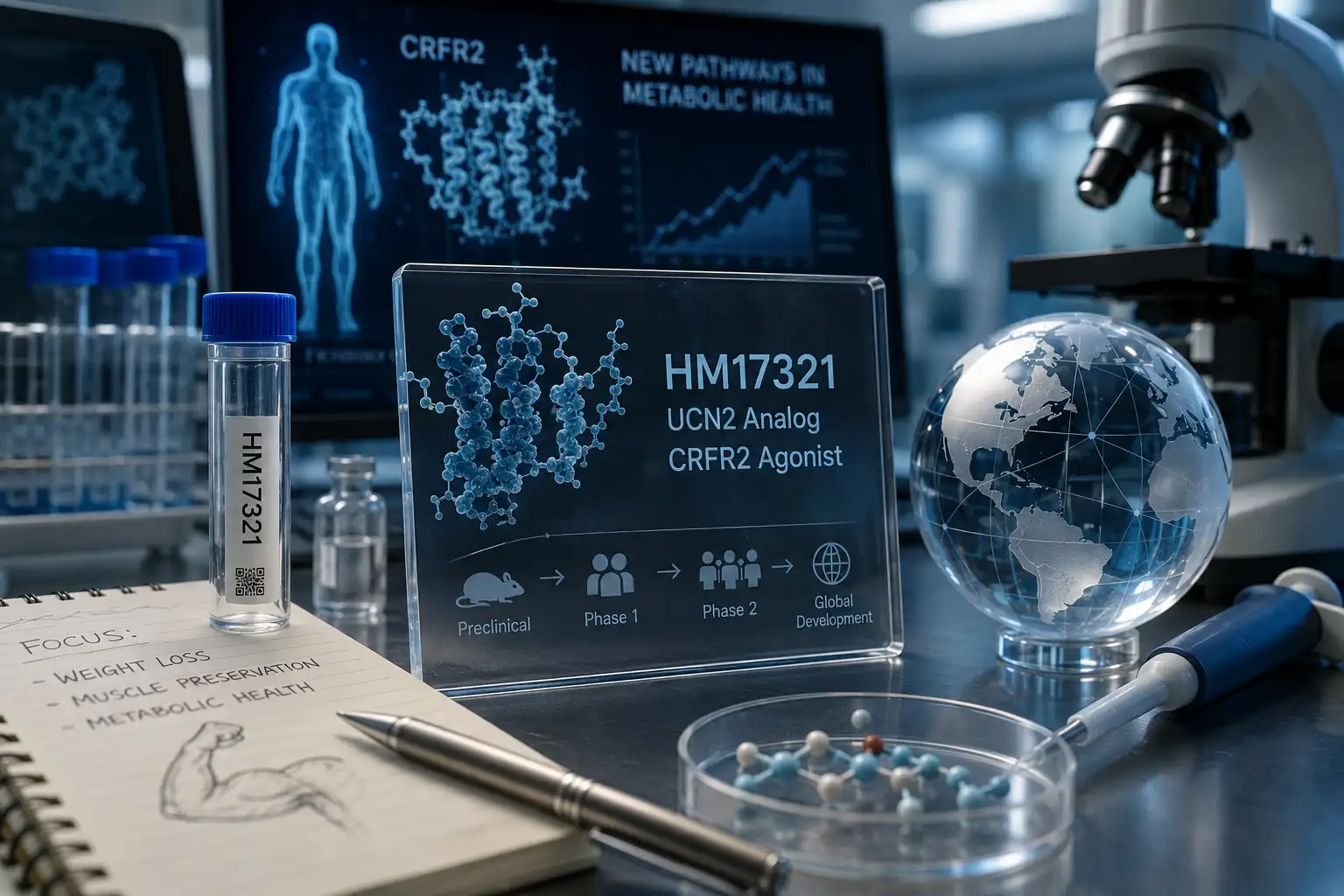
While Eli Lilly and Novo Nordisk battle for dominance in oral GLP-1 tablets, Roche is pursuing a different strategy: targeted diversification. On August 24, 2026, South Korean pharmaceutical company Hanmi Pharmaceutical announced it had signed an exclusive worldwide license agreement (excluding South Korea) with Genentech, a member of the Roche Group, for its metabolic drug candidate HM17321. The deal is historic for Hanmi: with a total value of up to $2.3 billion, it's the largest single licensing agreement in the company's history. The news sent Hanmi's stock soaring nearly 30 percent to 540,000 won.
The Compound: A New Mechanism Beyond GLP-1
HM17321 differs fundamentally from the industry's well-known blockbusters. While Wegovy, Ozempic, Mounjaro, and Zepbound all rely on the incretin principle (hormones such as GLP-1 and GIP, released by the gut in response to food intake, that regulate satiety and insulin release), HM17321 is a proprietary UCN2 analog (urocortin-2, an endogenous peptide hormone from the corticotropin-releasing factor family). The compound selectively activates the CRFR2 receptor (corticotropin-releasing factor receptor type 2), giving it a non-incretin mechanism of action — a potentially first-in-class approach (meaning a novel mechanism of action targeting this specific structure with no previously approved predecessors).
The most clinically relevant difference, however, lies not in the mechanism itself but in its effect on body composition: HM17321 is designed to promote weight loss while preserving fat-free body mass (muscle mass) — a point on which existing incretin-based therapies are regularly criticized in clinical practice, since they can cause the loss of a significant proportion of muscle mass alongside fat mass. In preclinical studies, the compound showed positive effects on weight reduction both as monotherapy and in combination with GLP-1-based therapies, both quantitatively and qualitatively (in terms of body composition). As a peptide compound, HM17321 also opens up potential for future fixed-dose combination products with existing incretin-based medications.
The compound is still in an early stage of development: in November 2025, Hanmi received Investigational New Drug (IND) clearance from the FDA, and a Phase 1 trial evaluating safety, tolerability, and pharmacokinetic and pharmacodynamic properties in healthy volunteers and people with obesity has been underway since. Important context: the efficacy and body-composition data reported so far come from preclinical (animal) studies and have not yet been confirmed in controlled trials in humans.
The Deal Structure in Detail
Under the terms of the agreement, Hanmi Pharm receives an upfront payment of $190 million. The remaining amount, up to the potential total of $2.3 billion, is tied to development, regulatory, and commercial milestones, plus tiered royalties on future net sales. Hanmi remains responsible for completing the ongoing Phase 1 trial; Genentech will then take over further development starting with Phase 2, including manufacturing and global commercialization. The agreement covers worldwide rights excluding Hanmi's home market of South Korea.
In-Young Choi, Senior Executive Vice President and Head of R&D at Hanmi Pharm, framed the deal programmatically: the paradigm of obesity treatment is evolving beyond pure weight reduction toward improving body composition and restoring metabolic health. Boris L. Zaïtra, Head of Roche Corporate Business Development, described the acquisition as expanding a growing cardiometabolic portfolio with a differentiated, potentially first-in-class therapeutic option.
The Bigger Picture: Roche's Catch-Up Race in the Obesity Market
The Hanmi deal isn't an isolated event — it's part of a systematic strategy through which Roche is attempting to catch up in an obesity market dominated by Novo Nordisk and Eli Lilly. The company entered the field in December 2023 with the $2.7 billion acquisition of Carmot Therapeutics. Since then, Roche has continuously expanded its portfolio:
CT-388 (enicepatide) — a dual GLP-1/GIP receptor agonist from the Carmot acquisition — achieved a placebo-adjusted weight loss of 22.5 percent at 48 weeks in a Phase 2 trial with 469 participants published in January 2026, with no plateau in effect yet apparent at that point. More than half of participants (54 percent) reduced their BMI below the obesity threshold of 30 kg/m², compared with 13 percent in the placebo group. Analysts at William Blair rated the data as comparable to Eli Lilly's Zepbound. The Phase 3 trial for CT-388 is planned to begin in the first half of 2026, with a targeted market approval by 2030.
CT-996, an oral GLP-1 compound also from the Carmot portfolio, is currently in Phase 2 trials; Roche additionally paid $100 million to Structure Therapeutics for a non-exclusive license to certain patents related to this compound.
Petrelintide, a long-acting amylin analog (amylin is an endogenous hormone released together with insulin that also promotes satiety), is being co-developed and co-commercialized under a collaboration with Zealand Pharma signed in March 2025 for a $1.6 billion upfront payment. Initial Phase 2 data from the ZUPREME-1 trial were presented in June 2026 at the American Diabetes Association's annual meeting and, according to Roche, showed a "compelling tolerability profile."
Emugrobart, an antibody from Roche's Japanese subsidiary Chugai, is designed to help patients preserve muscle mass while being treated with obesity medications such as Zepbound or Wegovy — a treatment goal conceptually related to that of the newly licensed HM17321, though achieved via an antibody rather than a peptide mechanism.
Manu Chakravarthy, Global Head of Product Development for Cardiovascular, Renal, and Metabolic Diseases at Roche, had already outlined the strategy clearly in September 2025: he disagreed with the notion that a company needs a single "mega-blockbuster" to take a leadership position in the obesity market — in fact, a company relying on only a single drug is at a significant disadvantage given the market's complexity and heterogeneity. Instead, Roche has explicitly stated its goal of becoming one of the three leading obesity companies — not through a flagship product, but through a diversified portfolio of different mechanisms of action that can potentially also be combined. The planned combination trial of CT-388 and petrelintide, set to begin in early 2026, aims specifically to reduce the gastrointestinal side effects that frequently lead to treatment discontinuation with existing GLP-1 drugs.
Context: Why Hanmi Is a Strategic Fit
For Hanmi Pharm, the deal represents the largest single agreement in the company's history and simultaneously confirms a strategic direction the South Korean company has been pursuing for some time: differentiated metabolic compounds outside the established incretin class. For Roche, meanwhile, the acquisition fits precisely into the pattern of its existing portfolio strategy: rather than betting on a single, all-or-nothing compound, the company is systematically assembling complementary mechanisms — GLP-1/GIP dual agonism (CT-388), oral GLP-1 (CT-996), amylin analogy (petrelintide), muscle preservation via antibody (emugrobart), and now non-incretin action via UCN2/CRFR2 (HM17321) — that could eventually be combined into differentiated combination therapies.
What This Means for the Industry
The Hanmi-Genentech deal exemplifies a shifting competitive dynamic in the obesity market: while public attention in 2026 has focused heavily on the direct head-to-head battle between Eli Lilly and Novo Nordisk over the oral GLP-1 tablet, other major corporations are methodically building diversified portfolios behind the scenes, betting on medium-term differentiation rather than short-term head-to-head competition. The fact that a South Korean company with a fundamentally new mechanism of action can strike a record deal with one of the world's largest pharmaceutical corporations also underscores how global and decentralized the innovation landscape in this market segment has become — a pattern also visible in other recent licensing deals with Asian biotech companies.
For patients, the long-term benefit of a compound like HM17321 could lie above all in its combinability: should the muscle-preserving effect be confirmed in human clinical trials, it could serve as a complement to existing GLP-1 therapies, addressing one of the central weaknesses of current obesity treatment — the unwanted loss of muscle mass during weight reduction.
Sources
- Hanmi Pharmaceutical, Press Release, Aug 24, 2026 – Hanmi Pharm Signs Exclusive Licensing Deal with Genentech for Novel Obesity Therapy
- PR Newswire, Aug 24, 2026 – Hanmi Pharm Signs Exclusive Licensing Deal with Genentech for Novel Obesity Therapy
- The Korea Herald, Aug 24, 2026 – Hanmi signs record $2.3b obesity drug deal with Genentech
- Dealroom.co – Hanmi licenses obesity candidate HM17321 to Roche's Genentech in deal worth up to $2.3bn
- BioPharm International – Hanmi Pharm Licenses Novel Obesity Drug HM17321 to Genentech in Deal Worth Up to $2.3 Billion
- PharmExec – Hanmi Pharm Enters $2.3 Billion Licensing Agreement with Genentech for HM17321
- The Pharma Letter – Hanmi Pharm inks obesity license deal with Genentech
- ChemDiv/Roche Pharma News – Roche Invests $2.3B in Hanmi's Non-GLP-1 Obesity Drug HM17321
- Fierce Biotech, Sept 22, 2025 – 'We have the will': Roche unveils strategy to become 'top 3' obesity company
- Fierce Biotech, Sept 23, 2025 – Roche's 'top three' obesity ambition not reliant on developing one megablockbuster
- Fierce Biotech, Jan 27, 2026 – Roche's GLP1/GIP drug from Carmot sees 22.5% weight loss, readies phase 3 trial
- BioPharma Dive, Jan 27, 2026 – Roche, trailing in obesity, showcases new data for GLP-1 shot
- MedCity News, Jan 28, 2026 – Roche Obesity Drug's Phase 2 Results Are Competitive, But True Test May Come From Combo Studies
- BioSpace, Jan 27, 2026 – Roche's 22% Weight Loss Benefit Seals GLP-1's Phase III Plans, Boosts Zealand Combo
- pharmaphorum, Jan 27, 2026 – Roche claims midstage win for obesity injectable
- Roche, Press Release, June 1, 2026 – Roche to present new data advancing its obesity portfolio at the American Diabetes Association's 2026 Scientific Sessions
- ClinicalTrials.gov – NCT06525935: A Study of Enicepatide (CT-388) in Participants With Obesity or Overweight With at Least One Weight-Related Comorbidity
- Roche For Patients – Clinical trial for Obesity – CT-388
Adrian Kempf
Pharma Communications Writer, Graphic & Media Designer Kirchzarten im Dreisamtal, Germany
Usage & Citation Permission
Full or partial reproduction of this text is permitted with source attribution. Please cite as: "Adrian Kempf, pharmavisuell"
This text may be forwarded, published, shared on social media, or posted publicly.
Editorial abridgment is permitted as long as the meaning and message of the text are not distorted.
This usage permission applies to the specialist articles published on pharmavisuell.de. Individually commissioned texts are subject to separately agreed usage rights.
© Adrian Kempf, pharmavisuell – Kirchzarten im Dreisamtal
https://pharmavisuell.de