
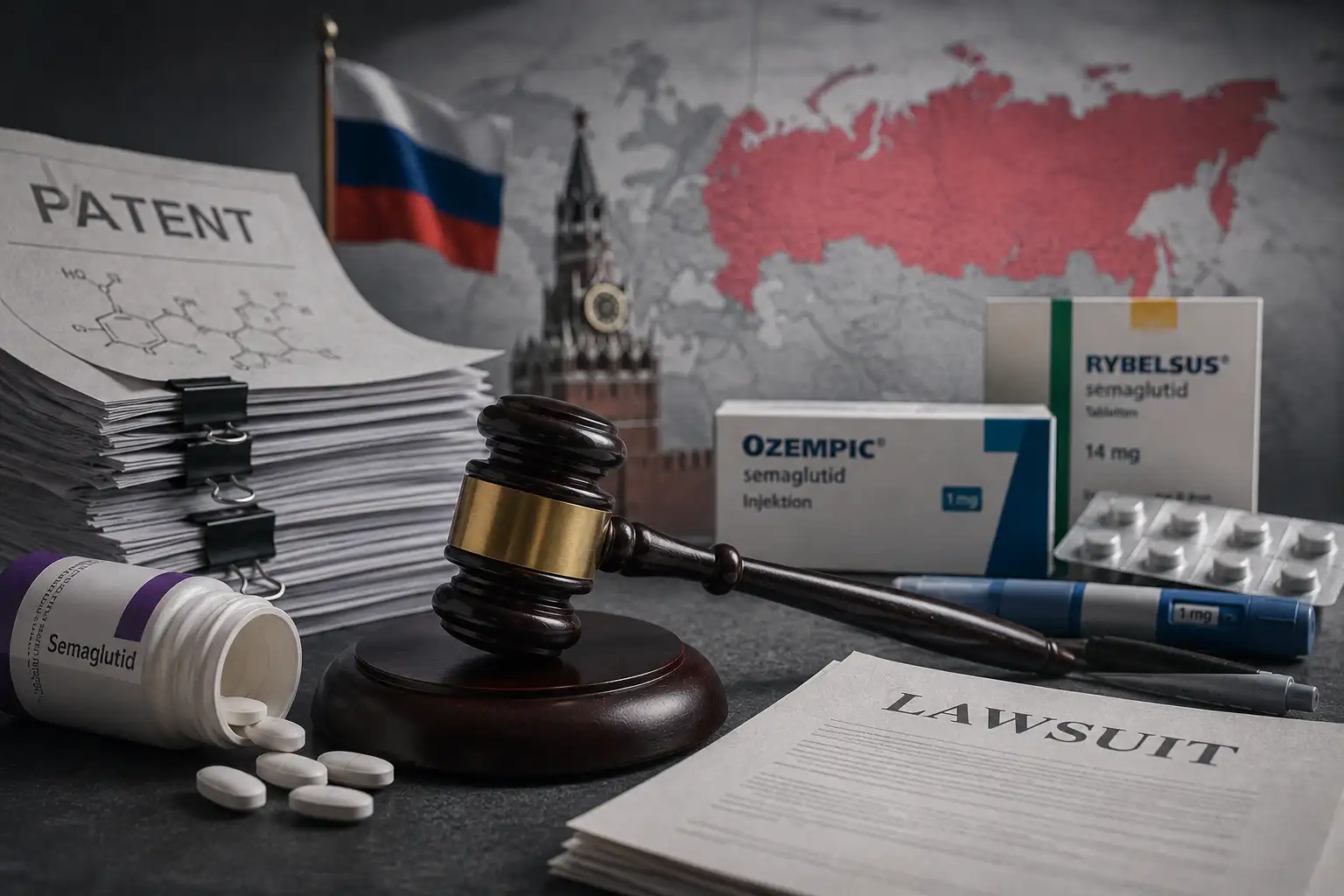
Russia's Patent Dispute Over Semaglutide
How a company that withdrew from a market became the target of its own patents
A Russian pharmaceutical company is suing one of the industry's largest corporations — and asking a court to grant it the right to use five patents protecting one of the world's highest-grossing drugs: semaglutide. What sounds at first like a regional legal dispute is actually a case study in how geopolitical sanctions dynamics, national patent law, and a global multi-billion-dollar market collide — with consequences that could reach far beyond Russia.
The Trigger: A Withdrawal With Consequences
Novo Nordisk gradually halted supply of its diabetes and obesity compound semaglutide to Russia — Ozempic as early as March 2023, with the tablet form Rybelsus following later that year. The Danish company cited sharply rising global demand and the priority of supplying other markets first.
The Russian government responded promptly. As early as December 2023, it granted compulsory licenses for semaglutide copies to Geropharm and Promomed, with PSK Pharma joining later. Eleven semaglutide analogs are now registered in Russia. Geropharm's own product, Semavik, has become the market leader among Russian generics — with more than one million units sold in its first year on the market, at a fraction of the original's price: while a month's therapy with Semavik costs roughly $44 in Russia, the price of the original in the U.S. without insurance can exceed $1,000. According to industry data, Novo Nordisk's share of the Russian semaglutide supply has fallen to roughly 0.2 percent.
The Current Case: Five Patents, One Court, One Tablet
In May 2026, Geropharm took a decisive step further. The company filed suit against Novo Nordisk at the Moscow Arbitration Court, seeking a simple, non-exclusive compulsory license covering a group of five patents that protect the tablet form of semaglutide, marketed in its original form as Rybelsus. The lawsuit was initially also directed against Russia's patent office, Rospatent, which would have been required to register the license. In August 2026, however, Geropharm withdrew this part of the claim, removing Rospatent as a defendant. The actual hearing against Novo Nordisk is scheduled for October 2026.
The case is not an isolated one — it fits into an already established line of jurisprudence. In a comparable proceeding, the Moscow Arbitration Court already granted the company Biokhimik — part of the Promomed group — a compulsory license on two patents relating to the manufacture of semaglutide preparations. Novo Nordisk was additionally ordered to cover the plaintiff's court costs of 50,000 rubles. The court explicitly rejected the company's argument that it had been unable to supply the market due to global demand and the priority of supplying other countries: favoring foreign patients over Russian ones, the court held, could not under these circumstances constitute a valid reason to refuse to resume supply or to deny a license.
Why This Is More Than a Regional Case
For industry observers, the legal logic of this case is especially notable: Russian courts are effectively flipping the burden of proof. It's not the compulsory licensee who must justify its market entitlement — it's the patent holder who must justify why it isn't exercising its own protective right through supply. A corporation that withdraws from a market thereby creates, on its own, the very grounds on which third parties can gain court-ordered access to its patents.
This is closely tied to the compulsory-licensing provisions in the Russian Civil Code (Article 1360), which allow the government to permit use of patents without the holder's consent in the interest of national security and public health — a tool that has been applied considerably more often since the sanctions imposed following the war in Ukraine. Russia is thus operating in a legal gray area of international patent law: the WTO's TRIPS Agreement generally permits compulsory licenses, for instance in cases of supply emergencies — but whether a self-inflicted supply halt resulting from sanctions constitutes such an emergency remains internationally disputed.
The Market at Stake
The economic dimension makes clear why this dispute is worth fighting. According to data from market research firm RNC Pharma, pharmacy sales of obesity medications based on semaglutide and tirzepatide in Russia reached roughly 17 billion rubles in the first quarter of 2026 alone — up from 5.2 billion rubles in the same period the previous year, more than a threefold increase within a single year. Globally, semaglutide is in any case among the highest-grossing compounds in pharmaceutical history: Ozempic and Wegovy together generate annual revenue in the low double-digit billions of dollars, with growth rates that have no real parallel in the industry.
At the same time, Novo Nordisk's patent protection is coming under pressure elsewhere too — independent of the Russian special case. In India, the Delhi High Court has provisionally allowed generic manufacturer Dr. Reddy's to produce and export semaglutide for countries where patent protection has already expired. Before the European Patent Office, two key formulation patents covering the oral dosage form of semaglutide were revoked after generic manufacturers successfully challenged them. And in several major markets — including Canada, Brazil, Turkey, and China — the core compound patents are set to expire in 2026 regardless, triggering a race among numerous international generic manufacturers.
What This Means for the Industry
The Geropharm vs. Novo Nordisk case illustrates how geopolitical realpolitik and patent law can collide — and how quickly a corporate supply decision can turn into a legal precedent. For Novo Nordisk, more is at stake than the Russian market alone, whose revenue contribution is by now marginal in any case: every successful compulsory licensing decision creates a legal argument that other countries with strained relations to Western manufacturers could invoke in the future.
For the pharmaceutical industry as a whole, the case is a signal that extends well beyond semaglutide: in a world of growing geopolitical fragmentation, the classic assumption that a patent holds the same value everywhere is becoming increasingly fragile. Supply decisions that make sense from a purely economic or logistical standpoint can, in certain jurisdictions, backfire — with direct consequences for global market and pricing strategies.
Sources
- GxP News, May 25, 2026 – Russian court grants Biokhimik compulsory licence for Novo Nordisk's semaglutide patents
- Vademecum, Aug 12, 2026 – Герофарм пытается получить в суде принудительную лицензию на семаглутид в таблетках
- BRICS Competition – Russia Issued a Compulsory License to Produce Analogues of Ozempic
- Geropharm, Oct 6, 2023 – GEROPHARM Relaunched Ozempic® in Russia, Under a New Name — Semavic®
- The Pharmaletter – Geropharm registers generic of Novo Nordisk's Ozempic in Russia
- El Global Farma, Feb 21, 2025 – Farmacéuticas rusas se lanzan a la semaglutida tras la salida de compañías internacionales del país
- Crane IP – Russian company intends to challenge Novo Nordisk patent on insulin derivatives
- Maucher Jenkins, Aug 22, 2025 – An Overview of the Semaglutide Patent Landscape
- Maiwald – Generic Manufacturers Target Novo Nordisk's Diabetes and Weight-Loss Drug
- finanzen.ch, Dec 8, 2025 – Ruling Increases Pressure on Novo Nordisk: Semaglutide Patent Protection Wavers
- Medscape Germany, Oct 7, 2025 – Patent-Free Weight-Loss Injections Reviewed: Opportunity for Affordable Therapies or Risk to Quality and Safety?
- Columbia Science and Technology Law Review – Understanding the Ozempic Patent Landscape
- Novo Nordisk A/S, SEC Form 6-K, FY2026 (India/China litigation)
- Pharmazeutische Zeitung, Jan 21, 2026 – Ozempic Copycats Are Coming
- aktien-global.de, Feb 1, 2026 – Novo Nordisk Stock: Patent Upheld (China Ruling)
Adrian Kempf
Pharma Communications Writer, Graphic & Media Designer Kirchzarten im Dreisamtal, Germany
Usage & Citation Permission
Full or partial reproduction of this text is permitted with source attribution. Please cite as:
"Adrian Kempf, pharmavisuell"
This text may be forwarded, published, shared on social media, or posted publicly.
Editorial abridgment is permitted as long as the meaning and message of the text are not distorted.
This usage permission applies to the specialist articles published on pharmavisuell.de. Individually commissioned texts are subject to separately agreed usage rights.
© Adrian Kempf, pharmavisuell – Kirchzarten im Dreisamtal
https://pharmavisuell.de