
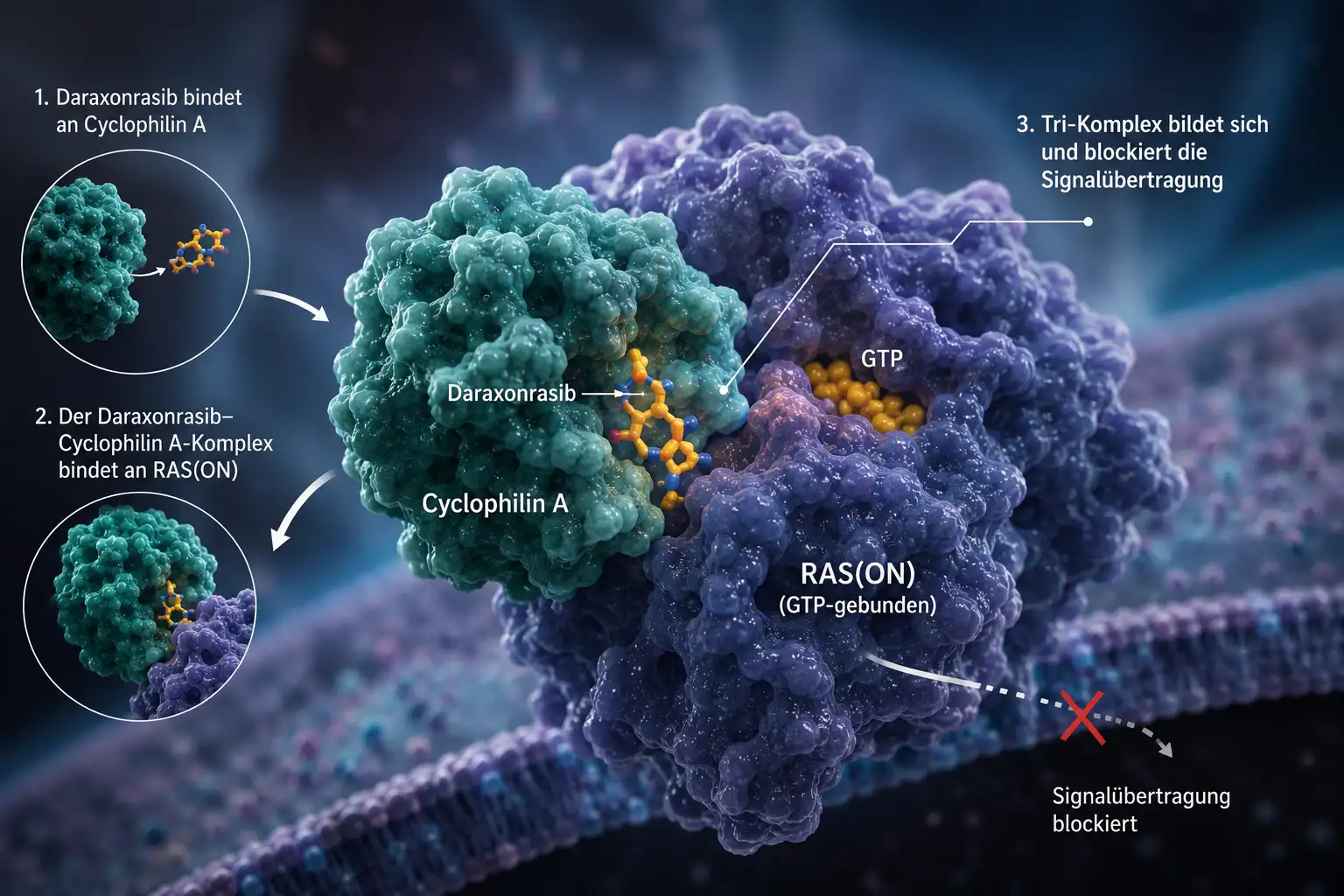
Mechanism of action of daraxonrasib: The compound first binds to the chaperone protein cyclophilin A. The resulting complex then binds to the active, GTP-bound form of RAS — RAS(ON). The resulting tri-complex sterically blocks signal transmission to downstream effector proteins, cutting off the growth signal within the tumor cell.
How a newly approved pancreatic cancer drug exploits a mechanism of action that was considered pharmacologically unreachable for decades — and what the tri-complex approach means for oncology far beyond this one indication.
Daraxonrasib: Why an "Untouchable" Protein Suddenly Became Touchable
The announcement sounds, at first glance, like many other oncology approvals: a doubled median survival time, a pill instead of an infusion, an "exceptionally difficult to treat" cancer. But read the announcement more closely, and you find a sentence with implications for oncology reaching far beyond pancreatic cancer: the molecule targets a protein that "until recently was still considered untouchable." That protein has a name many in the industry have known for decades — RAS.
Why RAS Was Considered Untouchable
RAS proteins are molecular switches that relay growth signals within the cell. Mutated RAS gets permanently stuck in the "on" position, driving uncontrolled cell growth. The problem for drug development: RAS proteins have a smooth surface, largely devoid of pockets. Classical small-molecule drugs, however, need a pocket to bind into — and RAS lacked exactly that for decades. Ever since RAS was identified as a cancer driver in the early 1980s, the molecule was long considered, in the field, the most prominent example of an "undruggable target."
The first breakthrough came only with mutation-specific compounds targeting a single RAS variant, G12C, which gained approval a few years ago. The problem: G12C is rare in pancreatic cancer. The far more common mutations there affect other positions on the same gene — most notably G12D. For these forms, there was no approved targeted therapy until now.
What Makes Daraxonrasib Structurally Different
Daraxonrasib, developed under the internal code RMC-6236, takes a different chemical approach than the first-generation G12C drugs. Rather than precisely blocking a single mutation, the compound is designed as a so-called tri-complex inhibitor: it binds simultaneously to the RAS protein and to an endogenous chaperone protein called cyclophilin A, forming a three-part complex that blocks the binding surface of the RAS protein needed for signal transmission. This mechanism also explains why the drug isn't limited to a single mutation, but simultaneously addresses several of the most common mutation variants at the gene's three central hotspot positions — and additionally captures non-mutated RAS in neighboring cells, which can also contribute to tumor growth.
That's the decisive difference from the first generation of RAS drugs: where G12C inhibitors occupied a narrow but deep niche, this multi-selective approach addresses a substantially larger share of RAS-mutated tumors. In pancreatic cancer, professional societies estimate that more than 90 percent of tumors carry a RAS mutation — making the target population for a broadly effective RAS inhibitor correspondingly large.
What the Trial Data Actually Show
The approval is based on a randomized Phase 3 trial involving roughly 500 patients with previously treated, metastatic pancreatic cancer. Median overall survival was approximately 13.2 months under daraxonrasib, compared with investigator's-choice standard chemotherapy. Important for both editorial and clinical context: this is a second-line therapy, not a replacement for first-line chemotherapy. The approval covers adult patients who have already received at least one prior systemic therapy or who are not candidates for combination chemotherapy.
The regulatory speed is also notable: in fall 2025, the FDA granted the compound a Commissioner's National Priority Voucher, a still-young pilot program that can shorten the review time for drugs of national interest to one to two months. Combined with prior Breakthrough Therapy Designation and Orphan Drug status, daraxonrasib thus went through one of the most accelerated approval pathways the FDA currently offers — the approval came roughly 6.5 months ahead of the standard decision date.
Why This Matters Beyond the Pancreatic Cancer Indication
The real reason for the attention in the field lies not solely in the new treatment option, but in its precedent-setting nature: for the first time, a multi-selective RAS(ON) inhibitor has reached market readiness for an indication where classical, mutation-specific approaches previously fell short. The developing company is simultaneously advancing additional RAS(ON) inhibitors with narrower mutation specificity through clinical trials, including against the G12D and G12V variants, as well as trials of daraxonrasib in non-small cell lung cancer, where RAS mutations also play a significant role.
For oncology as a whole, this means: a target protein that for more than forty years stood as the textbook example of pharmacological unreachability now has a second, structurally independent mechanism of action that extends beyond the narrow G12C niche. Whether this tri-complex approach proves similarly effective in other RAS-driven tumors — colorectal cancers, a substantial share of lung cancers — is something ongoing trials will show in the coming years.
Sources
Primary announcement
- Der Standard, Aug 26, 2026 – US Agency Approves Pancreatic Cancer Drug
Regulatory primary sources (FDA) 2. FDA – FDA Approves First in Class Targeted Therapy for Metastatic Pancreatic Cancer 3. FDA – FDA approves daraxonrasib for metastatic pancreatic adenocarcinoma (official approval details including RASolute-302 trial design, dosing, Project Orbis)
Company sources (Revolution Medicines) 4. Revolution Medicines – NDA Accepted for Review 5. Revolution Medicines – Orphan Drug Designation Announcement 6. Revolution Medicines – Publication Describing Molecular Basis of Tri-Complex Inhibitors 7. Revolution Medicines, SEC Form 10-Q (FY2025, Q2) – sec.gov 8. Revolution Medicines, SEC Form 10-Q (FY2026, Q1) – sec.gov 9. Revolution Medicines, SEC Form 10-Q (FY2026, Q2) – sec.gov
Scientific literature on mechanism of action 10. Nature, Oct 30, 2024 – Pharmacological restoration of GTP hydrolysis by mutant RAS 11. Cell, May 5, 2026 – Disrupted molecular glue complex drives RAS inhibitor resistance 12. bioRxiv, Apr 26, 2025 – Mechanisms of resistance to active state selective tri-complex RAS inhibitors 13. AACR Cancer Research, Sept 2024 – Targeting the oncogenic state of RAS with tri-complex inhibitors 14. Journal of Thoracic Oncology, Feb 2020 – Tri-complex Inhibitors of the Oncogenic, GTP-Bound Form of KRAS G12C
Medical/clinical context 15. AJMC, Aug 25, 2026 – Daraxonrasib Clears FDA as First RAS-Targeted Pancreatic Cancer Drug 16. Oncology Nursing News, Aug 26, 2026 – FDA Approves Daraxonrasib for Metastatic Pancreatic Adenocarcinoma 17. BioPharm International, Aug 27, 2026 – FDA Approves Daraxonrasib, Validating RAS(ON) Tri-Complex Platform
Patient organization 18. Pancreatic Cancer Action Network (PanCAN) – FDA Approves RASONQUE (daraxonrasib)
General coverage 19. NBC News, Aug 26, 2026 – FDA approves 'game-changing' pancreatic cancer drug 20. The Hill, Aug 26, 2026 – FDA approves pancreatic cancer drug Rasonque by Revolution Medicines 21. ABC News, Aug 26, 2026 – FDA approves breakthrough drug to treat advanced pancreatic cancer 22. CNBC, Aug 26, 2026 – Revolution Medicines gets FDA nod for targeted pancreatic cancer drug
Adrian Kempf
Pharma Communications Writer, Graphic & Media Designer Kirchzarten im Dreisamtal, Germany
Usage & Citation Permission
Full or partial reproduction of this text is permitted with source attribution. Please cite as: "Adrian Kempf, pharmavisuell"
This text may be forwarded, published, shared on social media, or posted publicly.
Editorial abridgment is permitted as long as the meaning and message of the text are not distorted.
This usage permission applies to the specialist articles published on pharmavisuell.de. Individually commissioned texts are subject to separately agreed usage rights.
© Adrian Kempf, pharmavisuell – Kirchzarten im Dreisamtal
https://pharmavisuell.de