
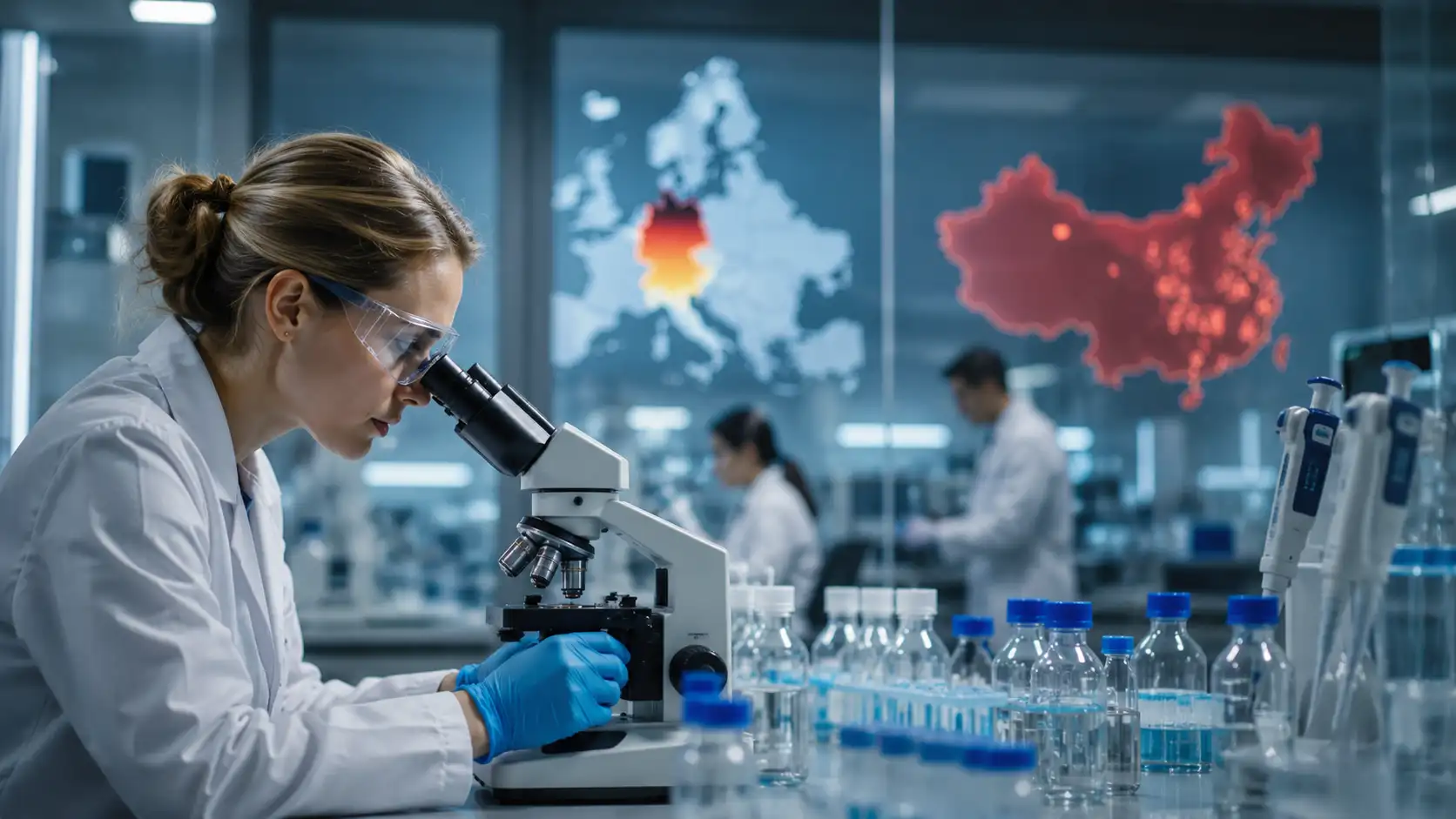
Record investment, shrinking share: What China's catch-up means for pharma R&D strategy
At first glance, the figures in the latest VCI report seem contradictory. In 2025, Germany's chemical and pharmaceutical industry invested just under 16 billion euros in research and development – more than ever before, and an increase of nearly six billion euros over 2015. Over the same period, however, the industry's share of global patent applications fell from 14 to 7.6 percent, nearly cut in half. Anyone who lays the two figures side by side runs into the real question behind the VCI announcement: Why does more money no longer translate into more patent applications? And what does that mean in concrete terms for companies deciding today where to locate their research?
The dynamics behind the numbers
A rising research budget paired with a falling patent share cannot be explained by "less innovative capacity" alone. Several factors are at work here, and they affect the pharmaceutical sector in particular, since according to the VCI it accounts for more than 60 percent of the industry's total research spending.
First, the cost of research itself is rising. Clinical trials, especially in later phases, are more demanding from a regulatory standpoint today – and therefore more expensive – than they were a decade ago. A flat or growing budget may thus fund fewer research projects in real terms than the headline figure suggests.
Second, patent applications are not a neutral yardstick for research output. They also follow strategic and legal logics that vary considerably from region to region. As VCI President Thomas Wessel describes it, China has systematically backed the transition from research to market readiness with patent protection. In other words, part of the Chinese patent surge is the product of a deliberate industrial policy of consistently securing legal protection for research results – regardless of how strong the underlying innovation actually is. The quadrupling of China's share of global chemical and pharmaceutical patent applications between 2010 and 2024, from 5 to 19 percent, is therefore also a signal of state-backed patent strategy, not solely of a leap in research quality.
What relocation means in practice
Perhaps the most revealing single figure in the report for the industry is the gap between expectations for Germany and for abroad: 29 percent of companies anticipate declining research spending in Germany, while only about one in five expects an increase. Abroad, by contrast, 41 percent expect growing budgets.
For the pharmaceutical industry, this is not an abstract debate about business location but a very concrete portfolio question: Where will new drug candidates be moved into clinical development, where will production capacity for new therapies be built, and where will the regulatory and scientific centers of excellence needed for the next generation of active ingredients emerge? Shifting research budgets abroad changes not only the cost structure but, in the long run, where expertise, supplier networks, and regulatory know-how become concentrated.
The role of the policy environment
The VCI puts three demands to policymakers: reliable funding, embedding research support in broader social and economic reforms, and greater predictability overall. For the pharmaceutical sector, this can be stated a bit more specifically. Reliable funding is not just a matter of direct research grants; it also concerns framework conditions such as approval timelines, reimbursement systems, and planning certainty around regulatory requirements, which have changed several times in recent years. A company planning a ten-year drug development program calculates not only with today's approval requirements but with expectations of how those requirements might change over the entire development period.
Takeaways for practice
For companies currently weighing research locations, partnerships, or portfolio decisions, the report's main lesson is a warning against an overly simple reading: a rising R&D budget alone is no proof of a stronger competitive position if the share of globally relevant innovation output is falling at the same time. The decisive question for the coming years will be whether the trend described here – more money, but a shrinking share of the global patent landscape – can be reversed, or whether it will accelerate further as research budgets continue to migrate abroad.
Original report
- WirtschaftsWoche, Aug 26, 2026 – Chemie steckt Rekordgelder in Forschung – und fürchtet China (dpa)
Syndication of the dpa report (identical content, different outlets)
- WLZ-Online, Aug 26, 2026 – Chemie steckt Rekordgelder in Forschung – und fürchtet China
- news.at, Aug 26, 2026 – Deutsche Chemieindustrie steckt Rekordgelder in Forschung
- Lippische Landes-Zeitung (LZ.de), Aug 26, 2026 – Chemie steckt Rekordgelder in Forschung – und fürchtet China
Primary source: VCI
- VCI press release, Dec 10, 2025 – Bericht des VCI für das Jahr 2025 – Branchen-Kennzahlen (original data set: sales, production, employment, 2026 forecasts)
- Presseportal/VCI, Aug 26, 2026 – Innovationsbudgets der Branche sind hoch / Schwächere Perspektiven für den Forschungsstandort Deutschland (additional figure: Germany's share of global R&D spending falls from 6.5% to 4.2%)
Contextual business coverage
- Der Aktionär, Oct 17, 2025 – Bayer, Evonik, Merck investieren Milliarden – aber bleibt die Forschung in Deutschland?
- Chemieindustrie-Online, May 22, 2025 – Chemie- und Pharmaindustrie plant Rekordinvestitionen in Forschung und Entwicklung für 2025
- IT Boltwise, Aug 26, 2026 – VCI warnt vor Asien: Chemie- und Pharma-F&E steigt 2025 auf 16 Milliarden Euro
Adrian Kempf
Pharma Communications Writer, Graphic & Media Designer Kirchzarten im Dreisamtal, Germany
Usage & Citation Permission
Full or partial reproduction of this text is permitted with source attribution. Please cite as: "Adrian Kempf, pharmavisuell"
This text may be forwarded, published, shared on social media, or posted publicly.
Editorial abridgment is permitted as long as the meaning and message of the text are not distorted.
This usage permission applies to the specialist articles published on pharmavisuell.de. Individually commissioned texts are subject to separately agreed usage rights.
© Adrian Kempf, pharmavisuell – Kirchzarten im Dreisamtal
https://pharmavisuell.de