
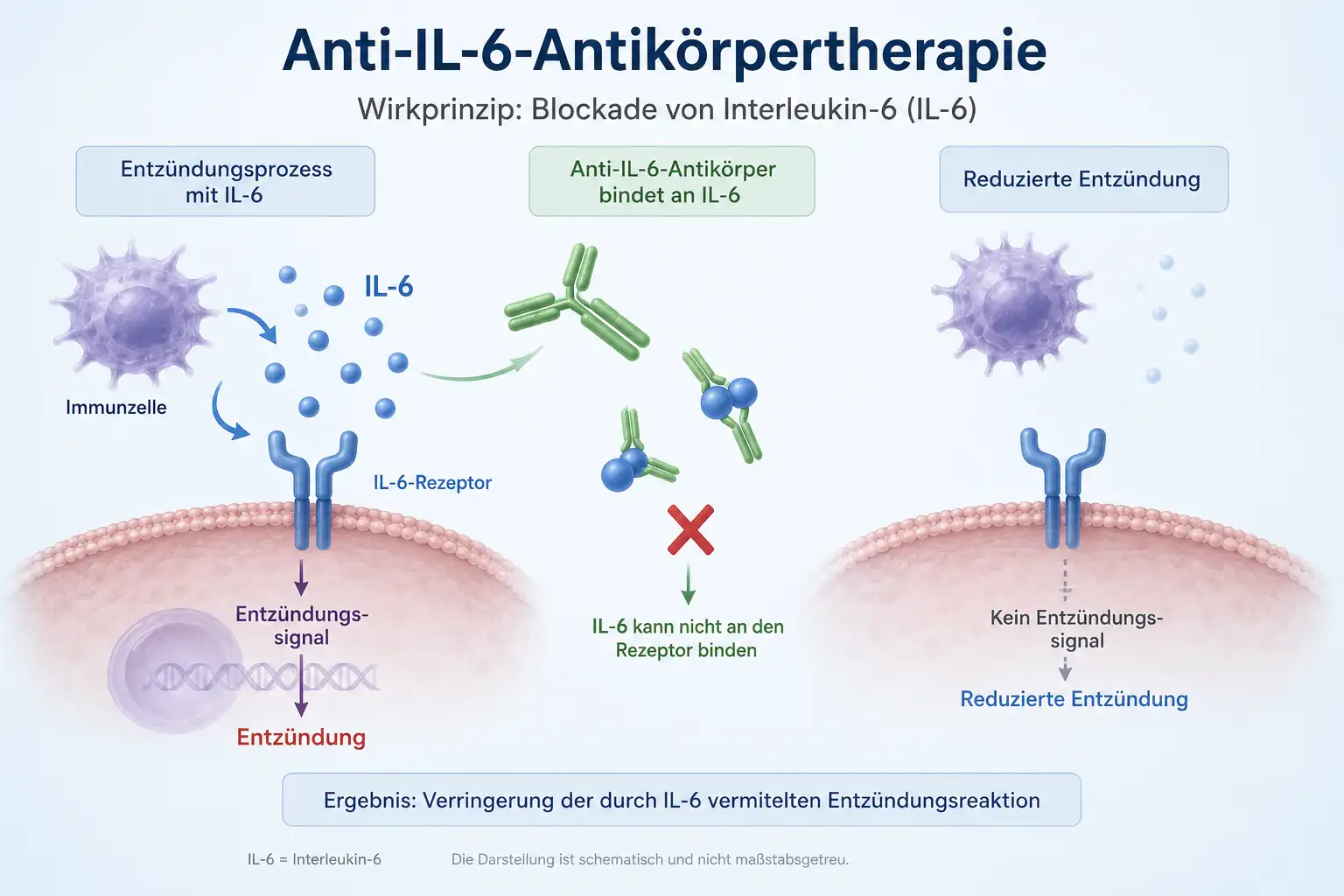
Mechanism of action of an anti-IL-6 antibody therapy: the antibody binds directly to the cytokine interleukin-6 (IL-6), preventing it from docking onto the IL-6 receptor. This blocks the pro-inflammatory signal and reduces the inflammatory response. Schematic, not to scale.
From regulatory filing to feature article: how "first anti-IL-6 antibody therapy" becomes a text that actually works
A few days ago, Roche subsidiary Chugai filed for approval in Japan for vamikibart, a drug for uveitic macular edema associated with non-infectious uveitis. The announcement itself is short: a new compound, a new indication, the first anti-IL-6 antibody therapy of its kind in the country. For anyone who has to turn announcements like this into copy, whether as a trade journalist, a PR professional, or a medical writer, those few lines contain a whole series of decisions that have to be made before any of it becomes a text worth reading.
I've worked in pharma communications for more than two decades, and since 2022 I've also worked hands-on in pharmaceutical quality control in the lab. That combination has made one thing especially clear to me: the difference between a text that is technically correct and a text that actually holds up almost never lies in the subject-matter knowledge itself. It lies in the translation work in between.
The first decision: who am I actually writing this for?
An announcement like this one can turn into at least four completely different texts, depending on who's reading it.
For the clinical trade press, what matters most is context: how does vamikibart differ mechanistically from existing treatment options for uveitic macular edema? The current standard of care is steroid treatment, which can carry side effects such as elevated intraocular pressure, glaucoma, or cataract formation; vamikibart is being positioned here as a non-steroidal alternative. For this audience, the text can and must be dense with technical detail, readers expect precise terminology, not a watered-down version.
For investors and business desks, the decisive question is different: what does this filing mean for Chugai's, or Roche's, pipeline? How large is the addressable market for this indication in Japan, and how does it fit into the competitive landscape? Here the mechanism of action recedes into the background, and strategic and commercial significance moves to the front.
For patients and their families, assuming the announcement is even communicated in that direction at all, almost one question dominates: what does this mean for me if I have this condition? Here the text has to explain what macular edema actually is, why it threatens vision, and what a new treatment approach could realistically change, without raising false hope while approval is still pending.
Anyone who tries to serve all three audiences with the same text will almost inevitably produce something that doesn't quite work for any of them. That's the most common structural mistake I see in practice: a corporate text tries to be technically precise, commercially persuasive, and patient-friendly all at once, and ends up unusable for all three purposes.
The second decision: how carefully can I handle the word "first"?
The phrase "first anti-IL-6 antibody therapy" is editorially trickier than it looks at first glance. A claim to exclusivity like this demands precision on several fronts.
First in what geographic scope, worldwide, or, as here, explicitly limited to Japan only? First for exactly which indication, Chugai itself, in the original announcement, narrows this precisely to "uveitic macular edema associated with non-infectious uveitis," not inflammatory eye disease in the broader sense. And: at what point in time does this claim apply, at the moment the filing was submitted, or only once approval has actually been granted, which is still pending?
These distinctions aren't nitpicking. Anyone who phrases a claim to exclusivity too generously risks not just a later correction but, in a regulated environment, a form of misleading communication that can become a compliance issue. In my own practical work, I've learned that any statement about novelty, efficacy, or superiority has to be scoped as tightly as the underlying data actually supports, not as broadly as it happens to read best.
The third decision: how much mechanism does the text really need?
An anti-IL-6 antibody works, put simply, by blocking interleukin-6, a signaling molecule that plays a central role in the body's inflammatory processes. In uveitic macular edema, swelling at the center of the retina arises, among other causes, from exactly these inflammatory processes. Vamikibart is administered intravitreally, meaning it's injected directly into the eye, a detail that matters for specialist audiences because it distinguishes the drug from systemically administered anti-IL-6 antibodies such as tocilizumab.
That single explanation is often enough for a trade article, provided it appears in the right place, exactly where the reader actually needs it to make sense of the paragraphs that follow. The most common mistake I see in technical and scientific writing isn't too little mechanism, it's too much: lengthy molecular-biology detours that bury the actual news under themselves. A good trade piece gives the reader just enough to understand the significance of the announcement and points to the primary literature or the prescribing information for everything beyond that.
What follows from this in practice
These three decisions, audience, precision around exclusivity claims, and how much technical depth to include, can't be answered with a fixed formula. They depend on where the piece runs, the product's regulatory status, and the client's communication goal. That's exactly what makes writing this kind of text demanding: understanding the facts isn't enough. For every single piece, you have to decide anew which version of the truth it should carry, without distorting any of it.
That, to me, is the point where it becomes clear whether a text came from someone who merely summarized the announcement, or from someone who understands what's at stake when a single phrase tips from precise into misleading.
Sources
Primary source: Chugai/Roche
- Chugai Pharmaceutical, Aug 25, 2026 – Vamikibart Filed for Regulatory Approval in Japan for Uveitic Macular Edema Associated with Non-Infectious Uveitis (official company announcement, original source of the filing news)
- Roche, Oct 17, 2025 – Roche presents new phase III pivotal data for vamikibart in uveitic macular edema (UME)(MEERKAT/SANDCAT study data, publication references)
Coverage of the filing
- cash.ch, Aug 25, 2026 – Roche-Tochter Chugai reicht Zulassungsantrag für Vamikibart in Japan ein
- finanzen.ch, Aug 25, 2026 – Roche-Aktie höher: Tochter Chugai reicht Zulassungsantrag in Japan ein (includes detail: orphan drug status since late June 2026)
- Pharma Japan, Aug 25, 2026 – Chugai Files Vamikibart in Japan for Uveitic Macular Edema
Clinical background on the phase III data
- Pharmazeutische Zeitung, Oct 22, 2025 – Uveitisches Makulaödem: Phase-III-Daten zum Neuling Vamikibart(details on MEERKAT/SANDCAT study design, efficacy data, current standard of care)
- MarketScreener/Chugai, Oct 20, 2025 – Roche's Announcement Regarding Vamikibart – Presentation of New Data
Trial registry
- ClinicalTrials Registry (ICH GCP), NCT05642312 – Vamikibart and Sham in Uveitic Macular Edema (study design, inclusion criteria, active substance RO7200220)
Adrian Kempf
Pharma Communications Writer, Graphic & Media Designer Kirchzarten im Dreisamtal, Germany
Usage & Citation Permission
Full or partial reproduction of this text is permitted with source attribution. Please cite as: "Adrian Kempf, pharmavisuell"
This text may be forwarded, published, shared on social media, or posted publicly.
Editorial abridgment is permitted as long as the meaning and message of the text are not distorted.
This usage permission applies to the specialist articles published on pharmavisuell.de. Individually commissioned texts are subject to separately agreed usage rights.
© Adrian Kempf, pharmavisuell – Kirchzarten im Dreisamtal
https://pharmavisuell.de